OVERVIEW OF 5S CERTIFICATION SERVICES
What is 5S?
5S originated in Japan in the early 1980s. This method was first applied by Toyota, when its leaders aimed to improve product quality and minimize waste in production lines. Today, 5S is a system widely implemented around the world, including in Vietnamese enterprises.
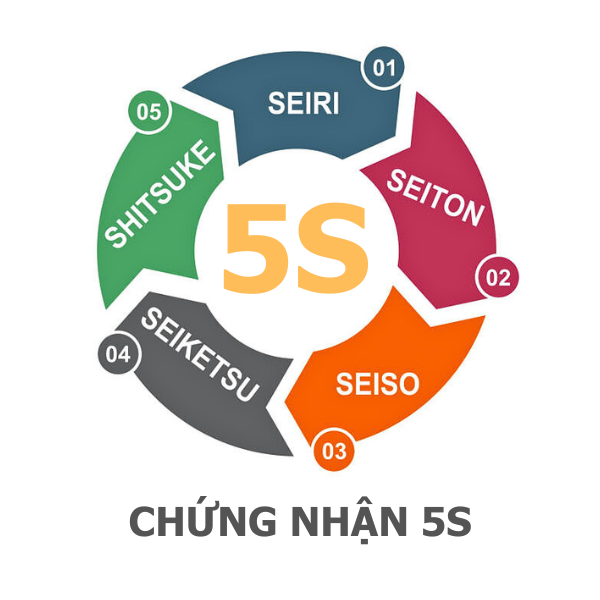
5S stands for five Japanese terms: Seiri (Sort), Seiton (Set in order), Seiso (Shine), Seiketsu (Standardize), and Shitsuke (Sustain).
- S1: Seiri (Sort) – Sort out and remove unnecessary items from the workplace.
- S2: Seiton (Set in order) – Arrange everything neatly for easy finding, seeing, taking, and storing.
- S3: Seiso (Shine) – Clean and maintain equipment, tools, and the workplace.
- S4: Seiketsu (Standardize) – Maintain workplace conditions by consistently implementing the first 3S.
- S5: Shitsuke (Sustain) – Be ready to educate and train everyone to voluntarily follow the first 4S.

What is the Good 5S Practice Program?
BENEFITS OF IMPLEMENTING GOOD 5S PRACTICES & OBTAINING 5S CERTIFICATION
Safety: A clean and well-organized workplace not only creates a safer working environment but also helps reduce the risk of accidents and injuries for employees.
Organization: Applying 5S helps create a well-structured workplace, enabling people to easily find tools, equipment, and resolve issues efficiently.
Enhanced image and service quality: Customers often evaluate a business based on professionalism and quality. A clean and organized workplace not only creates a positive impression but also strengthens customer trust and loyalty.
Waste reduction: By eliminating waste and optimizing workflows, 5S helps minimize the waste of resources and time, thereby reducing financial burdens for the business.
Development foundation: The 5S method serves as a strong foundation for enterprises to develop and implement other advanced management systems such as ISO 9001, ISO 14001, ISO 45001, ISO 22000/HACCP, TQM (Total Quality Management), TPM (Total Productive Maintenance), and LSS (Lean Six Sigma).
5S Certification: The Good 5S Practice Certificate issued by KMR Vietnam Certification Body not only helps businesses affirm compliance with 5S good practice requirements but also serves as a tool to improve operational efficiency, build credibility, and strengthen corporate culture.
✔️ In general, implementing the Good 5S Practice Program helps businesses achieve the following goals:
- Improve productivity (P – Productivity)
- Improve product quality (Q – Quality)
- Reduce costs (C – Cost)
- Improve transportation and delivery processes (D – Delivery)
- Ensure safety (S – Safety)
- Build a positive working culture and morale (M – Morale)
WHICH ORGANIZATIONS CAN APPLY 5S CERTIFICATION?
The 5S method can be applied to all types of organizations, from manufacturing to service sectors, and from small businesses to large enterprises.
It is especially suitable for organizations with workplaces involving a large number of machines, equipment, tools, or products that must comply with safety, quality, and environmental requirements. Businesses facing difficulties in workplace management, high production costs, excessive waste in production processes, or those aiming to improve productivity can apply the 5S method to address and improve these issues.
WHAT IS THE VALIDITY PERIOD OF A GOOD 5S PRACTICE CERTIFICATE?
The certificate confirming the implementation of Good 5S Practices is valid for 3 years from the date of issuance. When the 5S certificate expires, the enterprise should contact KMR Vietnam to carry out a recertification audit in order to be issued a new certificate for the next 3-year cycle.
SOME BEFORE-AND-AFTER IMAGES OF ENTERPRISES IMPLEMENTING 5S CERTIFICATION


Enterprises before and after applying the Good 5S Practice Program
HOW MUCH DOES A GOOD 5S PRACTICE CERTIFICATE COST?
The cost of 5S assessment and certification by certification bodies is typically based on the following factors:
✔️ Company/business scale (including number of departments, number of employees, etc.)
✔️ Industry sector (depending on the complexity of the certification scope, product type, and level of risk—high, medium, or low)
✔️ Certification locations (number of sites involved)
The certification fee paid by the enterprise usually covers a 3-year cycle:
- Year 1: Assessment and 5S certification issuance fee
- Year 2: First periodic surveillance audit fee
- Year 3: Second periodic surveillance audit fee
To reduce the financial burden for clients, the 5S certification assessment fee at KMR Certification Body is typically paid annually—each year’s fee is paid at the time of that year’s audit. However, clients may also choose to pay for all 3 years at once to receive preferential discount policies.
Therefore, to obtain an accurate quotation for 5S certification costs for your enterprise, please contact KMR for detailed pricing.
WHAT REQUIREMENTS MUST ENTERPRISES MEET TO OBTAIN 5S CERTIFICATION?
The 5S standard is not only a management method but also a set of criteria that helps organizations achieve an optimal working environment. The requirements of 5S include:
1. Seiri (Sort)
Requirements:
- Remove unnecessary items, equipment, and documents from the workplace.
- Identify and retain only necessary and useful items.
- Have a plan to properly store or dispose of unnecessary items (recycle, discard, or store).
=> Objective: Optimize workspace, reduce clutter and waste.
2. Seiton (Set in order)
Requirements:
- Necessary items must be placed in the correct locations, easy to find and use.
- Clearly define positions and storage methods for each type of item (signage, labels, numbering).
- Walkways and working areas must always be clear and unobstructed.
=> Objective: Save time, improve work efficiency, and reduce the risk of loss.
3. Seiso (Shine)
Requirements:
- All working areas, machinery, and equipment must be cleaned daily.
- Clearly define responsibilities and cleaning frequency for each department and individual.
- Promptly detect and address sources of dirt or hazards (oil leaks, dust, sharp objects).
=> Objective: Maintain a clean, safe, and professional working environment.
4. Seiketsu (Standardize)
Requirements:
- Standardize Seiri, Seiton, and Seiso activities into clear and easy-to-follow procedures.
- Integrate 5S requirements into the organization’s overall management system (e.g., ISO 9001).
- Conduct periodic inspections and evaluations to maintain effectiveness and drive improvement.
=> Objective: Ensure consistency and sustain long-term 5S implementation.
5. Shitsuke (Sustain)
Requirements:
- Build awareness and commitment to 5S among all employees.
- Conduct regular training to improve awareness and implementation skills.
- Establish reward and recognition mechanisms to encourage good 5S practices.
=> Objective: Make 5S a habit and an integral part of the corporate culture.
Complying with these requirements will help organizations achieve high efficiency in workplace management and improve overall productivity.
CONDITIONS FOR SUCCESSFUL IMPLEMENTATION OF THE GOOD 5S PRACTICE PROGRAM
1. Management commitment: Top management must demonstrate commitment by providing funding, resources, and strong support to drive the implementation of 5S practices.
2. Training: Ensure that all employees understand and comply with 5S procedures. Training programs should guide how to apply 5S principles in daily work and build a workforce with the skills and knowledge to promote continuous improvement.
3. Establishing standards and procedures: This helps maintain consistency and continuity in 5S implementation. Procedures should be designed to be easy to understand and follow, while remaining flexible for adjustments when necessary.
4. Promoting engagement: Creating a work environment where employees feel they are part of the improvement process and have an impact on workflows will enhance participation and commitment.
5. Evaluation and continuous improvement: Ongoing evaluation and improvement are essential to ensure that the 5S certification process continues to progress and improve. Organizations need to establish effective evaluation systems to monitor progress and identify opportunities for improvement.

Good 5S Practice Certification
WHY CHOOSE KMR ISO CERTIFICATION BODY?
- Expert auditors: KMR’s certification audit team consists of leading experts with extensive experience and deep understanding of your industry. Their constructive approach and compliance-oriented evaluation ensure confidence and reliability.
- Dedicated support team: Our office staff and coordinators provide full support to ensure that registration and certification audits are conducted smoothly and according to plan.
- Competitive and transparent costs: Our certification fees are competitive, clear, and transparent.
Global experience and expertise: With strong technical knowledge and high service standards, we have provided certification services to numerous organizations and enterprises across various industries in many countries worldwide. Our certification experts are always ready to support your organization—this is the mission of KMR ISO Certification Body. KMR is committed to accompanying your business not only during the certification process but also afterward.



main.comment_read_more