The ISO Survey of Management System Standard Certifications 2016

The ISO Survey of Certifications is an annual survey of the number of valid certificates to ISO management system standards worldwide

Executive Summary
The ISO Survey of Certifications is an annual survey of the number of valid certificates to ISO management system standards worldwide.
In order to compile the information in this survey, we contact accredited* certification bodies and request information about the number of valid certificates they have as at 31 December 2016. (ISO itself does not perform certification and therefore does not issue certificates). This results in the
most comprehensive overview of certifications to these standards currently available, despite the fluctuations in the number of certificates from year to year due to differences in the number of participating certification bodies and the number of certificates they report.
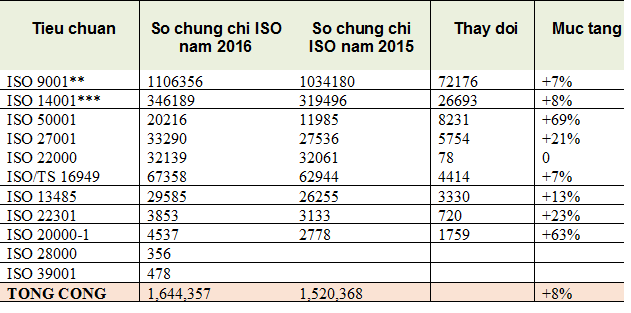
A summary of the 2016 results is shown below:
* Accredited certification bodies are those that have been independently evaluated by accreditation body members of the IAF, the world association of conformity assessment accreditation bodies

**ISO 9001:2008 (= 1025761 ) + ISO 9001:2015 (=80596)
***ISO 14001:2004 (=323023) + ISO 14001:2015 (=23167)

Key points:

This year we added two new management system standards, ISO 39001:2012 Road traffic safety (RTS) management systems - Requirements with guidance for use and ISO 28000:2007 Specification for security management systems for the supply chain,
after recommendations from international accreditation and certification experts that we consult annually. This brings the total of standards surveyed to 11.

A total of 1,643,117 valid certificates (of the 11 standards covered by the survey) were reported, compared to 1,520,368 the previous year, an increase of 8%.
/
A total of 1,106,356 valid certificates were reported for ISO 9001 (including 80,596 issued to the 2015 version) an increase of 7% on last year. A total of 346,189 valid certificates were reported for ISO 14001 (including 23,167 issued to the 2015 version) up 8% on last year.
A total of 18,976 valid certificates were reported for ISO 50001 for energy management (up 58% on last year) and 4537 valid certificates were reported for ISO 20000-1 for Service management in information technology (up 63% on last year). The strong growth seen for these two standards is likely to be related to the fact that they are both relatively new to the market.
ISO and IEC’s standard for information security, ISO/IEC 27001 experience the same annual growth of 20% annual increase as last year to 33,290 certificates worldwide, while ISO 13485 for medical devices and ISO/TS 16949 for the automotive sector were up 13% and 7% respectively

Source: www.iso.org


Related News

ISO 22000 Revision
ISO 22000 Revision
29/12/2016

6312 Views

Since the first publication of ISO 22000, users along the supply chain have been facing new food safety challenges.
APRIL 15–18, 2026 – THE 5TH HO CHI MINH CITY INTERNATIONAL FOOD & FOODSTUFF EXHIBITION – HCMC FOODEX 2026
17/04/2026

955 Views

From April 15–18, 2026, at the Saigon Exhibition and Convention Center (SECC), the 5th Ho Chi Minh City International Food & Foodstuff Exhibition – HCMC FOODEX 2026 officially took place, continuing the success of previous editions and affirming its position as one of the leading prestigious specialized events in Vietnam.
ESG REPORT & ESG ROADMAP IN THE EXPORT SEAFOOD SUPPLY CHAIN
06/04/2026

558 Views

In the context of globalization, the export seafood industry is increasingly subject to stringent international regulations, particularly from the EU market. Transparency, traceability, and sustainability are now mandatory standards, with ESG factors embedded across the supply chain, making the ESG report a key tool for demonstrating compliance and building global credibility.
HOW MUCH DOES ISO 22000 COST? UPDATED PRICE LIST 2026
24/03/2026

677 Views

The cost of ISO 22000 certification is one of the most frequently asked questions when businesses begin exploring food safety management systems. However, in reality, there is no fixed price applicable to all organizations. The cost varies depending on company size, industry sector, and the current status of internal management systems.
ISO 22000 Checklist: 10 Key Criteria
27/03/2026

522 Views

When implementing ISO 22000, many organisations struggle with where to start and which requirements must be fulfilled. In practice, developing a comprehensive ISO 22000 checklist enables organisations to: - Proactively control their food safety management system - Avoid nonconformities during audits - Shorten the time required to achieve certification Below are 10 key criteria in ISO 22000 that no organisation should overlook.
KMR HAPPY NEW YEAR 2024 AND ANNOUNCE LUNAR NEW YEAR HOLIDAY
05/02/2024

1124 Views

KMR VN would like to announce schedule for 2024 Lunar New Year holiday
KMR HAPPY LUNAR NEW YEAR 2026 AND ANNOUNCE LUNAR NEW YEAR HOLIDAY
13/02/2026

130 Views

KMR VN would like to announce the 2026 Lunar New Year holiday schedule!
New standard helps SMEs get ahead with ISO 14001
22/05/2019

4821 Views

Implementing an environmental management system (EMS) based on ISO 14001 might seem like a big task, but that doesn’t mean it is just for the bigger players in the market. Breaking it down into phases is the key.
ISO 22000 CERTIFICATI PROCESS: A STRUCTURED ROADMAP FOR FOOD BUSINESSES
23/03/2026

917 Views

In the context of increasingly strict controls on food safety and quality, ISO 22000 certification is not only a mandatory requirement of many partners but also a “passport” that enhances a company’s credibility and competitiveness in the market. However, many organizations still wonder: Where should implementation begin? How should it be carried out? How long does it take to achieve certification?

Comment
  • Your review